MYP6 Unit 6 - Energy transfers
Content
- 6u6.1 - Forms of energy
- 6u6.2 - Energy experiment circuit
- 6u6.3 - Energy transfer diagrams
- 6u6.4 - Energy conservation and Sankey diagrams
- 6u6.5 - Conduction, convection and radiation
- 6u6.6 - Candle and spirit burner investigation
- 6u6.7 - Energy transfers in sport
- 6u6.8 - Solar oven design project
- 6u6.9 - Renewable and non-renewable energy
- 6u6.10 - Energy choices and community action
Scheme of work
Energy is one of the most important ideas in science. It helps us explain movement, heating, light, sound, electricity, fuels, food, machines and life itself.
In this unit, you will learn how energy can be stored, transferred and transformed. You will use practical investigations, models, diagrams and design challenges to understand how energy moves through systems.
You will also explore how communities make decisions about energy resources, including renewable and non-renewable sources.
6u6.1 - Forms of energy
Energy can be stored in different ways and transferred in different forms. Scientists use energy ideas to explain how objects move, how materials heat up, how circuits work and how living things function.
Energy stores and forms
Students should become familiar with the following forms and stores of energy:
- kinetic or movement energy
- gravitational stored energy
- elastic stored energy
- chemical stored energy
- electrical energy
- sound energy
- thermal or heat energy
- light energy
- nuclear stored energy
Types and sources are not the same thing
A source of energy is where the energy comes from. Examples include food, batteries, sunlight, wind, petrol, coal and uranium.
A form or store of energy describes how the energy is stored or transferred. For example, a battery is a source, but the energy inside the battery is stored chemically.
Activity - Energy around the room
Task
- Students list examples of energy in the classroom and around school.
- For each example, students decide whether it is a source, a store or a transfer.
- Students sort examples into kinetic, gravitational, elastic, chemical, electrical, sound, thermal and light energy.
Discussion
- Is a moving car an example of kinetic energy, chemical energy, thermal energy or sound energy?
- Can one object involve more than one type of energy?
Summary
- Energy can be stored in different ways.
- Energy sources and energy forms are not the same thing.
- Most real situations involve several energy transfers at the same time.
Check your understanding
- What type of energy does a moving football have?
- What type of stored energy is found in food?
- Explain why a battery is an energy source, not an energy form.
6u6.2 - Energy experiment circuit
Energy transfers can be observed in many simple systems. In this lesson, students rotate through practical stations and identify the energy changes that take place.
Practical circuit
Each station should be short and observational. Students should record the starting energy store, useful output energy and any wasted energy.
Activity - Energy transfer stations
Suggested stations
- Candle with paper spiral.
- Transformer with spinning motor and switch.
- Dynamo flashlight and lamp.
- Wind-up plane or wind-up toy.
- String-pull truck.
- Ramp and car.
- Falling book.
- Electric car with remote control on a wire.
- Solar calculator.
Recording table
- Name of station.
- Starting energy store or source.
- Useful energy output.
- Wasted energy output.
- Evidence for the energy transfer.
Example: Dynamo flashlight
Movement energy from the hand is transferred to electrical energy inside the dynamo. The electrical energy is transferred to light energy in the lamp. Some energy is also transferred as thermal energy and sound.
Summary
- Energy can be transferred from place to place.
- Energy can be transformed from one form to another.
- Useful energy is the energy output that we want.
- Wasted energy is energy transferred in ways that are not useful to us.
Check your understanding
- Choose one station and describe the main energy transfer.
- Which station produced sound as wasted energy?
- Why is thermal energy often described as wasted energy?
6u6.3 - Energy transfer diagrams
An energy transfer diagram is a simple way to show how energy changes from one form to another. At this stage, students do not need exact numbers, but they should begin to show larger and smaller outputs by drawing arrows of different sizes.
Energy transfer diagrams
Energy transfer diagrams usually show an input energy, a useful output and one or more wasted outputs.
Example: Candle and paper spiral
Chemical energy stored in the wax is transferred by burning. Some energy is transferred as thermal energy, some as light energy and some of the thermal energy causes the air to move, turning the paper spiral.
Activity - Drawing transfer diagrams from practical stations
Task
- Choose at least four stations from the energy circuit.
- Draw an energy transfer diagram for each one.
- Label the input energy, useful output and wasted outputs.
- Make the arrows roughly match the relative size of the outputs.
Activity - Giant swing energy transfer
Watch a giant swing video and describe the energy transfers as the rider moves from high position to low position and back again.
- At the highest point, the rider has more gravitational stored energy.
- As the rider falls, gravitational stored energy is transferred to kinetic energy.
- At the lowest point, kinetic energy is greatest.
- Energy is also transferred to the surroundings by sound and heating.
Activity - PhET energy situations
Use pHet energy simulations to explore different energy transfer situations. Students should draw at least three transfer diagrams and note when more than one diagram is needed to show a sequence of transfers.
Summary
- Energy transfer diagrams show how energy moves or changes form.
- Many systems have useful and wasted energy outputs.
- Some systems need more than one diagram because transfers happen in a sequence (one thing after another.
Check your understanding
- Draw an energy transfer diagram for a wind-up toy.
- What energy store decreases as a swing moves downwards?
- Why might a single diagram not be enough for a complicated system?
6u6.4 - Energy conservation
Energy cannot be created or destroyed. This idea is called the law of conservation of energy. However, energy can become less useful when it is transferred to the surroundings, usually as thermal energy and sound.
The law of conservation of energy
If energy cannot be created nor destroyed, it stands to reason that the total amount of energy of any system cannot change. Energy just gets converted from one form to another.
Useful and wasted energy
A device is useful when a large part of the input energy is transferred into the output that we want. Energy that spreads to the surroundings as heat or sound or light is usually less useful.
Sankey diagrams
A Sankey diagram uses arrows to show energy transfers. Wider arrows show larger amounts of energy. The input arrow should equal the total of all output arrows.
For example, a lamp may transfer some electrical energy into useful light energy, but much of the energy may be transferred as thermal energy.

Activity - From transfer diagrams to Sankey diagrams
Task
- Start with a simple energy transfer diagram from the previous lesson.
- Add approximate numbers to the input and outputs.
- Draw a Sankey diagram using arrows of different widths.
- Check that total input energy equals total output energy.
Summary
- Energy is conserved, but it can become less useful.
- Sankey diagrams show useful and wasted energy transfers.
- The total width of the output arrows should match the input arrow.
Check your understanding
- What does conservation of energy mean?
- Why is wasted energy not really destroyed?
- In a Sankey diagram, what does a wider arrow show?
6u6.5 - Conduction, convection and radiation
Thermal energy can be transferred in three main ways: conduction, convection and radiation. These ideas help explain heating in homes, cooking, weather, solar ovens and many engineering designs.
Conduction
Conduction is the transfer of thermal energy through a material. It is most effective in solids, especially metals.
Convection
Convection is the transfer of thermal energy by the movement of a fluid. Liquids and gases are fluids.
Radiation
Radiation is the transfer of energy by waves. Thermal radiation can travel through empty space, which is how energy from the Sun reaches Earth.
Demonstration - Heat transfer and solar panels
Use demonstrations to show conduction, convection and radiation in the context of collecting energy from the Sun.
- Conduction: heat transfer through a metal rod or spoon.
- Convection: movement in warm water or warm air.
- Radiation: heating from a lamp or sunlight without direct contact.
Solar oven connection
A solar oven needs to absorb radiation from the Sun, reduce heat loss by conduction and reduce heat loss by convection. Reflective surfaces, insulation and lids can all affect the final temperature.
Summary
- Conduction transfers thermal energy through materials.
- Convection transfers thermal energy by moving liquids or gases.
- Radiation transfers energy by waves and does not need particles.
Check your understanding
- Why are metals usually good conductors?
- Why does warm air rise?
- Which type of heat transfer brings energy from the Sun to Earth?
6u6.6 - Candle and spirit burner investigation
Burning fuels transfer chemical energy into thermal energy, light energy and other forms. In this investigation, students compare the energy released by a candle and a spirit burner.
Criterion C formative investigation
This activity can be used to practise research question writing, hypothesis writing, variable identification, method planning, data collection and data processing.
Investigation - Candle and spirit burner
Possible research question
How does the type of fuel source affect the temperature increase of a measured volume of water?
Apparatus
- candle
- spirit burner
- beaker or boiling tube
- measuring cylinder
- thermometer
- clamp stand, boss and clamp
- heat-proof mat
- balance
- matches or splints
Safety
- Wear safety glasses.
- Tie back long hair.
- Keep flammable materials away from flames.
- Do not refill a spirit burner near a flame.
- Allow hot apparatus to cool before touching it.
Investigation sequence
- Lesson 1: write the research question and hypothesis.
- Lesson 2: identify variables, plan the method and prepare the data table.
- Lesson 3: collect data safely.
- Lesson 4: process data, graph results and write a conclusion.
Variables
The independent variable could be the type of fuel source. The dependent variable could be the temperature increase of the water. Controlled variables could include the volume of water, starting temperature, distance from flame to beaker, heating time and type of container.
Summary
- Combustion transfers chemical energy to thermal energy and light energy.
- A fair investigation requires careful control of variables.
- Data processing helps compare the energy transferred by different fuels.
Check your understanding
- Why must the volume of water be kept the same?
- Why is some energy from the flame wasted?
- Suggest one improvement to reduce heat loss in this experiment.
6u6.7 - Energy transfers in sport
Energy transfer ideas can explain many sports and physical activities. Archery is a useful example because elastic stored energy, kinetic energy, sound and heating can all be identified.
Archery energy transfers
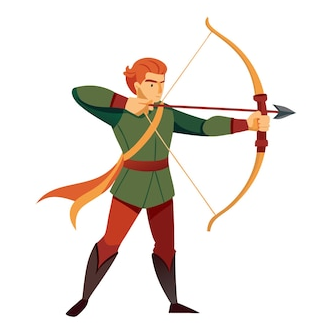
When an archer pulls back a bow, energy is stored elastically in the bow. When the string is released, some of this energy is transferred to the arrow as kinetic energy.
Activity - Energy transfers in archery
- Watch or analyse an archery example.
- Identify the starting energy store.
- Describe the useful energy transfer.
- Identify wasted energy transfers such as sound and heating.
- Draw an energy transfer diagram or simple Sankey diagram.
Reading review
Use the Forces, Energy and Motion reading, pages 158-163, to review key ideas before the solar oven project.
Summary
- Energy transfer diagrams can be applied to sport and movement.
- Elastic stored energy can be transferred to kinetic energy.
- Useful and wasted energy can be identified in real systems.
Check your understanding
- Where is energy stored when a bow is pulled back?
- What is the useful energy output when the arrow is released?
- Why is sound usually counted as wasted energy in this example?
6u6.8 - Solar oven design project
A solar oven uses energy from sunlight to heat food or water. A good design should absorb radiation from the Sun while reducing heat loss by conduction, convection and radiation.
Criterion B design project
Students work in teams to design, build, test and improve a solar oven. The project should include planning, labelled drawings, construction, testing, design changes and reflection.
Project - Solar oven
Suggested sequence
- Lesson 1: introduce project, form teams and brainstorm designs.
- Lesson 2: solar oven planning and labelled drawings.
- Lessons 3-4: construction.
- Lesson 5: first test and consideration of design changes.
- Lesson 6: design change and second test.
- Lesson 7: completion of group packet.
- Lesson 8: individual reflection.
Possible materials
- cardboard boxes
- aluminium foil
- black paper or black card
- cling film or transparent plastic sheet
- newspaper or other insulation
- tape, scissors and rulers
- thermometer or temperature probe
Design thinking
A good solar oven might use shiny surfaces to reflect radiation into the oven, black surfaces to absorb radiation, insulation to reduce conduction and a transparent cover to reduce convection.
Testing the solar oven
- Measure the starting temperature inside the oven.
- Place the oven in sunlight or under a lamp if weather prevents outdoor testing.
- Record the temperature at regular intervals.
- Compare the first test and second test after design changes.
- Explain which design features improved performance.
Summary
- Solar ovens use radiation from the Sun as an energy source.
- Design features can increase energy absorption and reduce heat loss.
- Testing and redesign are important parts of scientific and engineering work.
Check your understanding
- Why might black paper help a solar oven work better?
- How does insulation reduce heat loss?
- What evidence would show that your design change improved the oven?
6u6.9 - Renewable and non-renewable energy
People use many different energy resources. Some are renewable and can be replaced naturally over a short time. Others are non-renewable and will run out if we keep using them.
Energy resources
- fossil fuels
- hydroelectric power
- wind power
- solar power
- nuclear power
Renewable and non-renewable
Renewable energy resources are replaced naturally. Non-renewable energy resources are used faster than they can be replaced.
Activity - Sorting energy resources
- Sort energy-resource cards into renewable and non-renewable.
- Add advantages and disadvantages for each resource.
- Identify which resources depend directly or indirectly on the Sun.
- Discuss why no energy resource is perfect.
Fossil fuels and usefulness
Fossil fuels store chemical energy. They are useful because they can release large amounts of energy, but they are non-renewable and produce gases that can affect the environment.
Summary
- Energy resources can be renewable or non-renewable.
- Different resources have different advantages and disadvantages.
- Energy choices involve scientific, environmental, economic and social factors.
Check your understanding
- Name two renewable energy resources.
- Why are fossil fuels described as non-renewable?
- Why might a community choose more than one energy resource?
6u6.10 - Energy choices and community action
Communities need energy for homes, schools, hospitals, transport, communication and industry. Choosing the best energy option depends on location, cost, reliability, safety and environmental impact.
Moja Island
Students apply their knowledge of renewable and non-renewable energy to a community decision-making task. They must consider which energy sources are most suitable for a particular island community.
Activity - Moja Island energy choices
- Identify the energy needs of the island.
- Examine available energy resources.
- Compare renewable and non-renewable options.
- Recommend the best energy option or combination of options.
- Justify the choice using scientific and practical reasons.
Action - Renewable energy community display
Students design a display of any kind to inform the community about a specific type of renewable energy.
Display options
- poster
- leaflet
- model
- digital presentation
- short video
- interactive display
The display should include
- how the energy resource works
- whether it is renewable or non-renewable
- advantages
- limitations
- why the community should consider using it
Summary
- Energy decisions depend on evidence and context.
- The best energy option for one community may not be the best option for another.
- Scientific knowledge can be used to inform community action.
Check your understanding
- What factors should a community consider when choosing an energy source?
- Why might solar power be suitable in one place but less suitable in another?
- How can science communication help a community make better decisions?
Now test yourself
Review the key ideas from this unit: energy forms, energy transfers, Sankey diagrams, heat transfer, practical investigation, solar oven design and renewable energy choices.